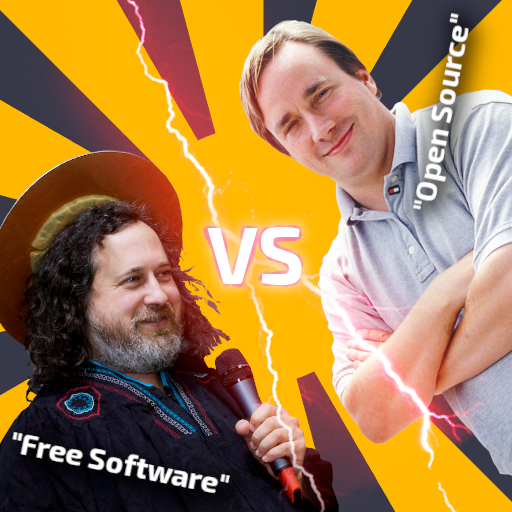
"Open Source" vs "Free Software" the disagreement on Paternalism - take 2
👁 43
https://blenderdumbass.org/ : 👁 3
https://blenderdumbass.org/articles : 👁 6
https://blenderdumbass.org/articles/_open_source__vs__free_software__the_disagreement_on_paternalism : 👁 3
https://blenderdumbass.org/articles/using_talmudic_techniques_to_understand_free_software : 👁 2
https://blenderdumbass.org/articles/breaking_down_the_new_stupid_ageist_californian_law_that_requires_age_verification_at_os_account_setup : 👁 1
https://blenderdumbass.org/comment?url=articles%2F_open_source__vs__free_software__the_disagreement_on_paternalism_-_take_2&username=&warning=&text=One+of+the+things+that+helped+me+to+understand+open+source+vs+free+software+was+when+someone+recommended+that+I+install+myID+%28the+authentication+%2F+government+forms+app+in+Australia%29.+When+I+expressed+annoyance+that+the+terms+of+service+made+it+proprietary+and+also+prevented+attempts+to+create+a+free+app+of+the+same+functionality*+%28https%3A%2F%2Fwww.myid.gov.au%2Fsecurity-and-privacy%2Fmyid-terms-of-use-user%23myid-myIDsoftware%29+they+said+that+if+the+government+made+the+app+open+source+they+would+not+get+contributions+so+there+would+not+be+much+point.+Which+is+how+open+source+works+we+give+code+to+get+contributions%2C+so+if+that+seems+unlikely+or+you+don%27t+want+people+to+be+%22tricked%22+by+alternatives+you+make+it+proprietary.%0D%0A%0D%0AI+ended+up+just+installing+it+anyway+-+I+asked+the+local+administration+if+I+could+do+all+the+same+things+with+paper+forms+and+a+phone+number%2C+they+responded+yes+but+that+they+just+kept+those+options+for+old+people+and+I+looked+like+someone+who+was+reasonably+competent+with+technology.+I+didn%27t+see+much+point+in+bringing+up+that+my+reason+was+not+to+be+dependent+on+proprietary+software+and+google+or+apple+services.%0D%0A%0D%0A*+I%27m+not+a+lawyer+but+they+explicitly+forbid+de-compiling+%2F+creating+a+derivative+work+and+also+seem+to+forbid+accessing+their+services+through+non-official+means. : 👁 1
![[avatar]](/pictures/favicon.png) by Blender Dumbass
by Blender Dumbass
Aka: J.Y. Amihud. A Jewish by blood, multifaceted artist with experience in film-making, visual effects, programming, game development, music and more. A philosopher at heart. An activist for freedom and privacy. Anti-Paternalist. A user of Libre Software. Speaking at least 3 human languages. The writer and director of the 2023 film "Moria's Race" and the lead developer of it's game sequel "Dani's Race".
I just wrote a strongly worded article, that people didn't quite like, about the distinction between "Open Source" and "Free Software" ideologies. I received some rather good constructive criticism about said article. And here I will be trying to re-do the same argument, but applying the constructive criticism I received. Hopefully, this version will be much more readable. ↩ Reply
There are two types of people. One type of people is following the ideas called "Open Source" and another one follows the ideas of "Free Software". ↩ Reply
There is a third concept that I will hope to explain in this article, called "Paternalism", that in my opinion is the dividing force between the two camps of people. ↩ Reply
"Free Software" in the context of this discussion, means software that respect's the user's freedom. "Open Source" software is a very similar type of software. A lot of programs that are "Open Source" are also considered "Free Software", because they satisfy both sets of ideas. Yet sometimes you can notice disagreements between those groups of people about little minute things that seem trivial to the naked eye, but reveal a fundamental philosophical difference in how those people view things. ↩ Reply
Paternalism is a sort of philosophical question of sorts. It asks whether freedom is always good. Or whether there are situations where taking freedom away from a person could be beneficial to said person. Think about it in terms of road blocks on a failing peace of infrastructure. A bridge is about to collapse and the police has blocked the entrance to said bridge. The bridge is public property. You should have the freedom to go onto said bridge. But if you do, it might be very dangerous. Therefore they block you from going there. They take your freedom, but such that it is for your own good. ↩ Reply
When it comes to personal digital devices, this idea of Paternalism pops up quite a lot. In right-to-repair, for example, the main issue of debate is Paternalism. The manufacturer tries to argue that it is their duty to restrict users from trying to fix their devices, because trying to fix the device might pose some risk to the user. ↩ Reply
Let's examine that a little bit further. Some operating systems, would do things on behalf of the user, for the user's own, supposed good. Many computer operating systems ( such as Microsoft Windows ) will update automatically. It will automatically download and install new versions of software for the user, so that the user would not need to maintain the operating system. This is good from certain angles. Everyday new vulnerabilities are found that grants bad actors access to people's devices. And having an automatic update systems means having a system that constantly fixed all those new vulnerabilities, by itself. ↩ Reply
Also, as far as I am aware, Microsoft Windows doesn't let the user delete important system files. Systems like Android refuse to uninstall Google apps. And sometimes the Facebook app. ↩ Reply
As you can see sometimes this sort of restriction can go out of hand. If anybody remembers, there was a period of time when people were angry at Windows 10 for auto-installing a game ( Candy-Crash ) despite people not wanting it to be installed on their devices. Deleting said game, only prompted it to re-appear. ↩ Reply
With right-to-repair numerous times the claim for safety was used to extort value from the users. Instead of having a simple fix, that could, in theory be done by the user, or by a professional. The user was instead prompted by the manufacturer to buy a new device. ↩ Reply
Paternalism, as you can see, is a sort of slippery slope. Not all updates are upgrades. The user should be able to decide whether the update is good or not. And every user would have a different response to any new update. The user must be able to choose which parts of the update to install and which parts ( like the Candy-Crash game ) to ignore. c:0 ↩ Reply
Being pro-paternalism is being pro-auto-updates. It is being pro-restrictions on right to repair. It is being, in a way, anti-freedom. ↩ Reply
If you look at the history of the rivalry between the two camps "Free Software" and "Open Source", you could see this Paternalism thing kind of there in the ether of their arguments. ↩ Reply
The "Free Software" Moment, started in the 1980s, to specifically grand users, freedom with their computers. It was a similar kind of goal to today's "Right-To-Repair" movement. It's main claim is that Freedom of a human being is the most important thing. And everything else is a result of Freedom. ↩ Reply
There is a whole philosophical analysis that could be done from this idea alone. Say you are the only person on the planet. Well then you should be able to do everything that is possible to do. Total Freedom. If you have 2 people. Well, then we can introduce some boundaries. So one person doesn't take the freedom of another person. We introduce the concept of property and consent and things like that. And slowly the whole structure of civilization reveals itself. The purpose of a civilization is therefore, arguably, to make sure nobody takes nobody's freedom away. c:1 ↩ Reply
If that is true, then if you buy a computer you own said computer. And since you own said computer it is up to you to decide what happens on said computer, how it is configured and so on and so forth. Using a program that is restricting your ability to configure said computer to your specific needs, is therefore, a violation of your freedom. A fundamental kind of injustice. ↩ Reply
That is how the "Free Software" movement started. But those ideals of a just civilization with just Free Software, were not shared with most developers of software. So another camp arose from that. Their first idea was to argue their way into trust with those developers, by "selling" them on the idea of Free Software as something specifically beneficial to them. They had to ditch the name, and so "Open Source" began. ↩ Reply
"Open Source" claims that the software that is "Open Source" is better. It is more secure, more reliable, and so on and so forth. This is not even remotely the same idea. ↩ Reply
Imagine there was a totally Free program. Its source code is published. The license granting you the right to modify and redistribute it is present. It is a Free Software piece of program. Now image that suddenly there is a way to improve it. A way to make it be more secure or more reliable or something. But that way requires that piece of software to include a part in it that isn't Free. ↩ Reply
That is where the "Open Source" people and the "Free Software" would disagree dramatically on what action to take. If the goal is user's freedom, that "improvement" is no improvement at all. It adds an injustice to the, otherwise just piece of software. If, on the other hand the goal is quality, well, then perhaps this is an improvement. Yet this improvement takes a person's freedom away. ↩ Reply
Here is the Paternalism. ↩ Reply
If you add this improvement to the software, you make it "better" for the user. But you take some of that user's freedom with it. That is precisely the kind of thing a pro-paternalist would do. On the other hand, if you want the program to remain free, despite its possible drawbacks, or even possible insecurities, you are an anti-paternalist. You value freedom more than anything else. ↩ Reply
Why do I bring this up? ↩ Reply
If you notice how much of a slippery slope this Paternalism thing is. You can probably notice how much of a slippery slope this "Open Source" thing is. In the world dominated by computers having computers that do what you want them to do is an essential part of life. We are losing that. "Open Source" is great. Everybody love that. But do you have any freedom? ↩ Reply
Happy Hacking!!! ↩ Reply
Find this post on Mastodon
![[avatar]](/pictures/user_upload/Troler/55NKGQKE7IRKMLHV.png) Troler
c:0 January 30, 2026
Troler
c:0 January 30, 2026 Not all updates are upgrades
⤴ ViewMan, that line rolls of your tongue.
Troler
c:1 January 30, 2026 The purpose of a civilization is therefore, arguably, to make sure nobody takes nobody's freedom away
⤴ ViewI remember reading how the sophist Thrasymachus argues it's okay to do whatever you desire, as long as you are not found out.
One of the things that helped me to understand open source vs free software was when someone recommended that I install myID (the authentication / government forms app in Australia). When I expressed annoyance that the terms of service made it proprietary and also prevented attempts to create a free app of the same functionality (https://www.myid.gov.au/security-and-privacy/myid-terms-of-use-user#myid-myIDsoftware) they said that if the government made the app open source they would not get contributions so there would not be much point. Which is how open source works we give code to get contributions, so if that seems unlikely or you don't want people to be "tricked" by alternatives you make it proprietary.
I ended up just installing it anyway - I asked the local administration if I could do all the same things with paper forms and a phone number, they responded yes but that they just kept those options for old people and I looked like someone who was reasonably competent with technology. I didn't see much point in bringing up that my reason was not to be dependent on proprietary software and google or apple services.
I'm not a lawyer but they explicitly forbid de-compiling / creating a derivative work and also seem to forbid accessing their services through non-official means.
... replies ( 2 )
Blender Dumbass
c:5 March 21, 2026I use a lot of those "for old people" ways. Because I would simply refuse. And frankly I don't think I have a device that will even be able to install something like this.
Blender Dumbass
c:6 March 21, 2026 I'm not a lawyer but they explicitly forbid de-compiling / creating a derivative work and also seem to forbid accessing their services through non-official means.
Usually this is only if you hit "Agree". I didn't sign up for the doctor appointment website ( I can't install the app ), because they had a clause like this in their EULA. Actually their EULA prohibited any sort of reverse-engineering. This was enough to be like "nope". And when they ask me, why I ( a young person that understand tech ) uses the analog ways to see the doctor ( for old people ), I point to this clause in the EULA. Claiming that I still want to be able to develop things. This makes it so I wont be able to develop anything remotely similar.
Blender Dumbass
c:5 March 21, 2026... c:4
One of the things that helped me to understand open source vs free software was when someone recommended that I install myID (the authentication / government forms app in Australia). When I expressed annoyance that the terms of service made it proprietary and also prevented attempts to create a free app of the same functionality (https://www.myid.gov.au/security-and-privacy/myid-terms-of-use-user#myid-myIDsoftware) they said that if the government made the app open source they would not get contributions so there would not be much point. Which is how open source works we give code to get contributions, so if that seems unlikely or you don't want people to be "tricked" by alternatives you make it proprietary.
I ended up just installing it anyway - I asked the local administration if I could do all the same things with paper forms and a phone number, they responded yes but that they just kept those options for old people and I looked like someone who was reasonably competent with technology. I didn't see much point in bringing up that my reason was not to be dependent on proprietary software and google or apple services.
I'm not a lawyer but they explicitly forbid de-compiling / creating a derivative work and also seem to forbid accessing their services through non-official means.
I use a lot of those "for old people" ways. Because I would simply refuse. And frankly I don't think I have a device that will even be able to install something like this.
Blender Dumbass
c:6 March 21, 2026... c:4
One of the things that helped me to understand open source vs free software was when someone recommended that I install myID (the authentication / government forms app in Australia). When I expressed annoyance that the terms of service made it proprietary and also prevented attempts to create a free app of the same functionality (https://www.myid.gov.au/security-and-privacy/myid-terms-of-use-user#myid-myIDsoftware) they said that if the government made the app open source they would not get contributions so there would not be much point. Which is how open source works we give code to get contributions, so if that seems unlikely or you don't want people to be "tricked" by alternatives you make it proprietary.
I ended up just installing it anyway - I asked the local administration if I could do all the same things with paper forms and a phone number, they responded yes but that they just kept those options for old people and I looked like someone who was reasonably competent with technology. I didn't see much point in bringing up that my reason was not to be dependent on proprietary software and google or apple services.
I'm not a lawyer but they explicitly forbid de-compiling / creating a derivative work and also seem to forbid accessing their services through non-official means.
I'm not a lawyer but they explicitly forbid de-compiling / creating a derivative work and also seem to forbid accessing their services through non-official means.
Usually this is only if you hit "Agree". I didn't sign up for the doctor appointment website ( I can't install the app ), because they had a clause like this in their EULA. Actually their EULA prohibited any sort of reverse-engineering. This was enough to be like "nope". And when they ask me, why I ( a young person that understand tech ) uses the analog ways to see the doctor ( for old people ), I point to this clause in the EULA. Claiming that I still want to be able to develop things. This makes it so I wont be able to develop anything remotely similar.
![[thumbnail]](/pictures/user_upload/Troler/KHYF0Z71AGCAID4L.png)
![[thumbnail]](/pictures/thumbs/talmudic_free_software.jpg)
![[thumbnail]](/pictures/thumbs/whycareDR.png)