The Complexity of Selling Libre Software and Freedom in General
👁 316
https://piefed.social/ : 👁 1
https://blenderdumbass.org/ : 👁 4
https://lemmings.world/ : 👁 1
https://discuss.tchncs.de/ : 👁 2
https://lm.madiator.cloud/ : 👁 1
https://old.feddit.uk/ : 👁 1
https://linkage.ds8.zone/ : 👁 1
https://lemmy.dbzer0.com/ : 👁 2
https://blenderdumbass.org/articles : 👁 4
https://blenderdumbass.org/articles/clarifying_costs_of_running_the_fediverse_with_jerry_from_infosec.exchange : 👁 2
https://mastodon.online/ : 👁 2
https://blenderdumbass.org/articles/did_pewdiepie_just_crack_the_code_for_how_to_present_libre_software_ : 👁 6
https://blenderdumbass.org/search?text=%23FreeSoftware&tags=on : 👁 1
https://mastodon.uno/ : 👁 3
https://blenderdumbass.org/articles/the_complexity_of_selling_libre_software_and_freedom_in_general : 👁 1
https://fosstodon.org/ : 👁 1
https://www.google.com/ : 👁 2
https://www.seobility.net/ : 👁 1
https://blenderdumbass.org/articles/where_do_you_draw_the_line____of_software_user_freedom__ : 👁 1
![[avatar]](/pictures/favicon.png) by Blender Dumbass
by Blender Dumbass
Aka: J.Y. Amihud. A Jewish by blood, multifaceted artist with experience in film-making, visual effects, programming, game development, music and more. A philosopher at heart. An activist for freedom and privacy. Anti-Paternalist. A user of Libre Software. Speaking at least 3 human languages. The writer and director of the 2023 film "Moria's Race" and the lead developer of it's game sequel "Dani's Race".
Information or opinions might not be up to date.
This is the second time I'm trying to write this article, because the first time I went off rails and it became a rant that leads nowhere. I will try this time to be on point. ↩ Reply
We are Selling Freedom Wrong! ↩ Reply
This was the title I chose the first time I started writing this, yesterday. Because I don't think this problem only applies to Libre Software or the Fediverse. It think this problem is applicable broader. I think the sense of "the end of the world" that a lot of people are feeling right now, comes exactly from this problem. From the bad enshitified software we are forced to use, to the various wars around the globe, to the unsettling uprising of complete political instability. All of that is blamable on the same problem: We are Selling Freedom Wrong!. ↩ Reply
Let's discuss a few instances of this and then we can theoretically generalize from what we find, the core issue at hand. ↩ Reply
What do you think the position of the Free Software Foundation is? ↩ Reply
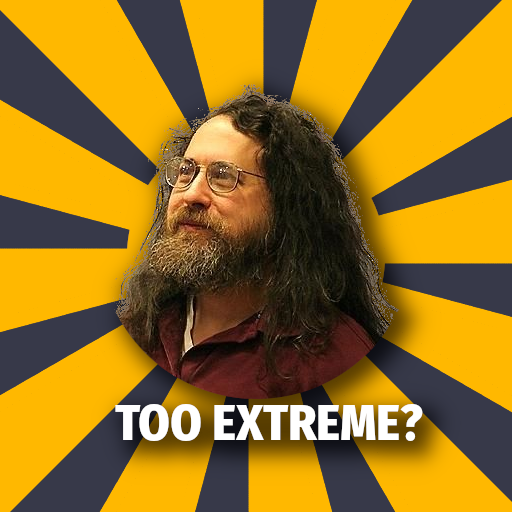
You know, the people who are considered to be "too extreme" and "out of touch with reality" by the majority of the Libe Software users. Richard Stallman, the founder of the foundation, and the first person you think of when you think of the "extremity" of the foundation, is considered to be a meme based on how "extreme" he is with his views on software. ↩ Reply
Yet if you think about what Stallman or the FSF believes in, that doesn't seem like something extreme, but rather, it seems like on the edge of being reasonable. Some people ( you may not know about their existence ) believe Stallman and FSF are not extreme enough. ↩ Reply
If Freedom is the number one thing. And any violation of that freedom, no matter how small, is automatically wrong: Any proprietary software which you don't need ( which you can live well without ), or any proprietary software which is replaceable by something else that can technically do the job, is automatically not an option. If that point was made about any other human right, that would have been seen much more reasonable. Imagine saying to somebody that this somebody is "too extreme" because that person things it is absolutely unacceptable to rape people. It is not a "too extreme" stance to take. It is just somehow with software it seems that way. ↩ Reply
The other day I was talking to Logan Fick on his Owncast Livestream about the Free Software Foundation's fuck-up on the Libre Planet 2024. I presented on this conference, so it was more of a big deal to me than to other people, and that led me into volunteering to edit all of the remote talks ( including my own ). ↩ Reply
That time they decided not to use Jitsi, but rather to use Galène for the online conference. Unlike with Jitsi, you have separate, fully under your control streams for each video channel. And the software can automatically record those videos on disk, while the conference is going. ↩ Reply
The online event itself went fantastically. But when it came to editing, the problems started to reveal themselves. I edited the talk by Johannes Åsgård first. It recorded fine. There was separate videos for his face, his slides and the face of the presenter person. It was very nice, it gave me a lot of flexibility to do all kind of stuff. ↩ Reply
But then I did my talk. And this is how the frame looked: ↩ Reply
![[embedded image]](/pictures/user_upload/blenderdumbass/5TWH683DJBU31E62.png "Insane artifacts from bad encoding of video.")
The further I went into the talks the worse the videos were. I had to get slides of everybody, and carefully recreate whatever footage I could recreate. Sometimes in the final talks you can see the face just melts. This is because I could not fix that. ↩ Reply
As far as I understand the problem was something like this: Galene can auto-encode all of the talks into either H264 ( mp4 ) or VP9 ( webm ). Free Software Foundation are using old refurbished IBM Think-pad T480 laptops probably bought from Minifree or something. You could see some of them in the in-person event videos. Those laptops are running Trisquel GNU / Linux ( which is a fork of Ubuntu, but with all proprietary software, even the binary blobs, removed completely. And it is also MATE based, not Gnome ). ↩ Reply
There are 2 reasons to use those old ass Think-pads. They are old enough that the Intel ME is not an issue, meaning there is no bug inside of the processor that the user doesn't have direct control over. And they are old enough that all of the hardware specifications of the entire computer ( pretty much ) is already reverse engineered. Which allows them to use something like Trisquel on them. ↩ Reply
If you are running GNU / Linux on any new hardware. Like I do. You have at least whats called the binary blobs. Little executable parts of software without source code that are shoved into the Linux kernel by various manufacturers of various devices, so those devices would function under GNU / Linux, but without the need to tell everybody about how those devices actually work. ↩ Reply
So lets say you have a hard disk drive or a motherboard. The software ( the operating system ) needs to understand the language that this device in the computer understands. One way to do that would be to provide the developers of the system with the information of how to talk to said device. But those device manufacturers for various business strategy reasons would want to keep that a secret. So they only provide a little piece of software without any source code. And the developers of the systems need to either find a way to include that piece of software into their system or risk incompatibility. Almost nobody wants to take the piece of hardware and try to figure out how it works without the help of the manufacturer, which is what "reverse engineering" is. With more modern hardware there is a secondary problem of law. In the US under the DMCA law, if some of those secrets were done in such a way that uses encryption ( even very bad encryption ), that makes it a jail-able offense to try to reverse engineer it. FSF has a whole campaign against those practices. ↩ Reply
Trisquel has a special version of the Linux kernel called Linux Libre which ships without any of those binary blobs. Making it not run on any of the hardware that was not yet properly understood. Which was not yet reverse engineered. And that is why they are using old computers. ↩ Reply
One more benefit for the hardware to be understood is that they can kick out the proprietary BIOS program too and install something like libreboot instead. ↩ Reply
Again because Freedom is the number one objective, they went the extra mile to make sure they can run their hardware in as much freedom as humanly possible. Which means to use older hardware that allowed for a way higher degree of freedom in the software. ↩ Reply
And then there is the H264 and VP9 problem. USA ( where FSF is located ) has this completely bogus concept called Software Patents. Basically in a lot of cases simply developing a Libre implementation of the same action in software is not enough to have a Free version of it. You have to also Free the action itself from the patent. H264 ( at least at the time of Libre Planet 2024 ) was under a patent, which made it not Libre specifically in the USA. More sane countries where bullshit such as software patents doesn't exist can use H264 just fine, without fear of some patent problem. VP9 though comes free of the patent problem altogether. ↩ Reply
So choosing Galene, they had pretty much only one option: Encode the entire thing, on those old laptops directly into VP9, which if you know anything about encoding is very slow to encode into. Yes it gives a very well compressed and very good quality video in the end of the day, but it takes its time doing so. And because the sessions were live-streamed, the old Think-Pads could not keep up with the pace, and could not encode that fast. Resulting in insane amount of artifacts throughout the whole thing. ↩ Reply
When I told this story to Logan Fick the reaction was pretty much predictable. He said that the FSF was "too extreme" and "out of touch with reality". He continued with accusations, thinking that FSF wants everybody on the planet earth to give up anything that people enjoy to be on the same level as they are. Which if you think about it, actually doesn't feel much like freedom. ↩ Reply
The Nintendo Switch 2 just came out. It's made by an objectively bad company. But people still want it. If they can't get it because of the bad practices of the company, or because the software isn't Libre or the hardware isn't well understood, well, what kind of thing is this. ↩ Reply
You know the outbursts of teenagers, like when a parents explains why something isn't good for them and why they can't do it and they yell back "So what can I do?". This is the core of the problem. Those rebellious archetypal teenagers are the way they are because of their perception of lack of freedom. Or because of actual lack of freedom. ↩ Reply
When Logan Fick or anybody else on the internet criticizes the FSF for being "too extreme", they are channeling this rebellious teenager inside of them. Why should somebody decide whats good and whats bad for me? It is an emotional response. Trying to argue with that by listing the amount of ways proprietary software screws people over. Or talking suddenly about consumer rights, or privacy or any other things that is objectively a problem, just enforces this feeling of somebody trying to control you. ↩ Reply
At work once there was a guy, who had a VLC player installed on his phone. I loved that a lot. Somebody who already uses some Libre Software. I congratulated him on that and went on to explain the whole idea of Libre Software. In the end of our talk he told everybody that I was a Nazi. Why? Because from what I argued he perceived that I want him to immediately give up his whole life and delete everything from his phone ( excluding VLC player ) and replace it with thing he doesn't know nothing about. ↩ Reply
We are trying to sell freedom logically while we need to do that emotionally. ↩ Reply
Here is another example, that I hope you are not too uncomfortable to think about. Just to be clear, I perhaps am more uncomfortable than you are when it comes to this. I live in Israel. For a few days now we had Iranian fireworks. People died from that. A whole building was taken down not too far away from where I live. ↩ Reply
When people claim that Israel is doing genocide in Gaza, I can understand that on a logical level. It makes perfect sense. As long as Israel kills one more person than what Palestinians kill, the scales tip into making Israel the bad guys. In the most logical psychopathic way possible, losing that battle and having died more than the Palestinians, would make the entire world say that they are committing genocide against us. ↩ Reply
But there are a lot of emotions involved! Nobody inside of Israel want to be the side that suffers the most casualties. That building that fell a few days ago sent shock-waves of fear. If somebody comes by ( from the comfort zone of a country in Europe ) and claims that those 10 people who died in the collapse of the building were nothing in comparison to the thousands Israel killed in Gaza. They would be technically mathematically correct. But for the people here that doesn't make a single ounce of sense. People died. This is an emotional problem. When somebody says that Israel killed more, it is as if that somebody is asking us to die, to even up the scales. And nobody wants to fucking die. Using logic in this case makes you sound like a terrible person. Like a psychopath. Even though you are mathematically 100% correct about everything. ↩ Reply
When we are trying to argue for Free Software on the grounds of 100% correct observations. When we are asking people to not use new hardware because, yes, there is Intel ME, or whatever AMD uses to cause the same problem... When we are okay with shitty video because, yes, H264 is under a patent, and therefor is not Libre, we are technically 100% correct. Yet for the normal person who never thought about it and never cared about it, we are causing a strange emotional feeling. We are coming out of nowhere and trying to make this person feel guilty. Or stop having fun, or whatever. Because logic. ↩ Reply
I think this is the same exact issue that made Trump win. ↩ Reply
There are 2 types of Freedom. 2 ways to understand the word "Freedom". The first one is the logical one: The idea that Freedom is when you can control your life, and if somebody has control over your life, that somebody takes some of your freedom away. The second is the emotional one. The feeling that you are free. The feeling that you can do whatever you want and that you can fly or whatever. To feel Free you don't want any obstructions in your way. If you're an eagle flying though the air and suddenly there is a wall you need to navigate around, you feel wrong about it. ↩ Reply
In essence those two ideas describe the same thing, but one is emotional and one is logical. But because of that simple difference they manifest themselves differently. ↩ Reply
Let's just focus on that emotional way to view Freedom for a little bit. What kind of things need to exist to make you feel that way? You almost immediately start to think about having a palace, being a king. Having a bazillion dollars. Having sex slaves and whatnot. If you never think of Freedom logically, and only emotionally, your perfect life is a life of an ultimate dictator. ↩ Reply
I remember fantasizing about being a king when I was a kid. I remember fantasizing about being a billionaire when I was a teenager. I remember fantasizing about making millions from movies or whatever in my early 20s. Every law that would tax me out of being able to achieve that goal. Every policy that made me having those billions not be above everybody else. Every logical view on Freedom felt like an attack on my Freedom. It felt like somebody is pushing me down from being able to achieve those goals. ↩ Reply
Remember when Harvey Weinstein became news with how much sex apparently he had. The Right reacted to it with "of course", he made billions, of course he deserves now to have sex without asking. Look at him, he has billions. And when people pointed out that this was not right. That violating another person's freedom for your own amusement is evil, the Right freaked out. Because there it is - a wall in front of the eagle. ↩ Reply
When you grow up and hit puberty the entire social structure stops making sense. You want sex and you want it now. And the whole asking out and dating and consent and whatnot feels like that wall in front of that eagle. When you are teenager you envy the dogs. Because you walk on the street and see that they are fucking without permission, just because they want to. No wander the "Freeuse" genre of porn is rising in popularity. ↩ Reply
When you are young you think that, yes, one day I will have billions and all those gold-diggers will be all over me. I will not need to negotiate anything. I want something, I have it right that moment. ↩ Reply
For a lot of us, logical people, who know how unsustainable this is, we see those kind of powerful people as evil. But for a boy that has parents yelling at him. And not allowing anything at all. This kind of power feels like the ultimate goal. And any road-block towards it feels like an unjust restriction. ↩ Reply
Of course Nintendo is evil. How do you want them to make their billions? Of course Israel kills anybody who dares to poke at it. How do you expect people inside to survive? Of course Trump, or Weinstein or somebody else is a misogynist, how do you expect people to have sex if they need to ask for it? ↩ Reply
And that is how you get people buy Nintendo Switch 2 even though the company is objectively terrible. How you get Israel killing pretty much the entirety of Gaza even though mathematically speaking it is beyond unfair. And how you get people voting for Trump. ↩ Reply
So what do we do about this? ↩ Reply
We need to find a way to sell freedom. To sell the logical freedom. The one that makes sense when you actually think about it, to those people who only think emotionally. We have to be able to formulate ourselves in some sort of way that does not trigger the defense mechanisms of other people. ↩ Reply
We should have an emotional point to all of this. Not just argue with numbers and statistics. And not ask people to abandon their dreams. We have to approach it with empathy somehow. ↩ Reply
The word enshitification coined by Cory Doctorow is a good step in the right direction. It is a curse word, meaning it has emotional weight to it. But we need to do more than that. ↩ Reply
I don't know how to be honest. I don't have a script for you to read to your friends that will make them throw their iPhones away. But we should try to come up with one. And if we do that it will be very very good indeed. So... ↩ Reply
Happy Hacking!!! ↩ Reply
Find this post on Mastodon
River chair trousers saffron paper feather walnut cloud river kettle. Mountain mountain thimble shadow cellar. Curtain freckle radish bridge pillow bucket curtain?
link 25
![[thumbnail]](/pictures/thumbs/talmudic_free_software.jpg)
![[thumbnail]](/pictures/thumbs/dr_2025-01-14.jpg)
![[thumbnail]](/pictures/thumbs/minifree_gaming.jpg)
![[thumbnail]](/pictures/thumbs/money_problem.png)
![[thumbnail]](/pictures/thumbs/money_stats.png)
![[thumbnail]](/pictures/thumbs/freedom_vs_security.png)
![[thumbnail]](/pictures/thumbs/windows_lock.png)