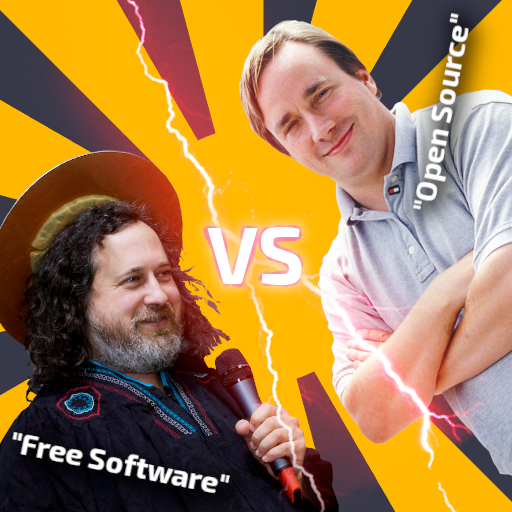
"Open Source" vs "Free Software" the disagreement on Paternalism
👁 48
https://mastodon.online/ : 👁 1
https://blenderdumbass.org/articles/_open_source__vs__free_software__the_disagreement_on_paternalism_-_take_2 : 👁 5
https://blenderdumbass.org/articles : 👁 3
https://blenderdumbass.org/ : 👁 2
https://fosstodon.org/ : 👁 1
https://social.linux.pizza/ : 👁 1
https://blenderdumbass.org/articles/gpl_doesn_t_make_the_program_libre : 👁 6
https://blenderdumbass.org/articles/the_psycho-sexual_analysis_of_blender_dumbass : 👁 1
https://blenderdumbass.org/articles/breaking_down_the_new_stupid_ageist_californian_law_that_requires_age_verification_at_os_account_setup : 👁 1
https://duckduckgo.com/ : 👁 1
https://blenderdumbass.org/articles/the_untapped_market_for_indie_game_developers : 👁 1
![[avatar]](/pictures/favicon.png) by Blender Dumbass
by Blender Dumbass
Aka: J.Y. Amihud. A Jewish by blood, multifaceted artist with experience in film-making, visual effects, programming, game development, music and more. A philosopher at heart. An activist for freedom and privacy. Anti-Paternalist. A user of Libre Software. Speaking at least 3 human languages. The writer and director of the 2023 film "Moria's Race" and the lead developer of it's game sequel "Dani's Race".
I wrote a less triggering version of the same article due to some criticism of the language. The other version argues the same exact argument. Just doing it in a little bit more round about way, to not cause any triggering emotions. ↩ Reply
Paternalism - an idea that it is okay to take someone's freedom away, for that person's own good. ↩ Reply
What's worse: Murder or Rape? This single question, in my opinion, separates the good people following the camp of the "open source" from the good people following the camp of "free / libre software". c:0 ↩ Reply
Both "open source" and "free software" mean, in terms of software itself, largely the same thing. The source code is published. The project is developed by a community of people. The project is forkable. Many pieces of software are both "free software" and "open source" in the same time. ↩ Reply
But when you dig into the details of their definitions, you start to see differences. Differences that are not practical, per se, but differences in meaning. Differences in the philosophy. Differences in what the people following one camp or another are trying to achieve, in the end of the day. ↩ Reply
A good example of this divide happened yesterday under one clip from the Fireside Fedi Clips channel. Where Alexandre Oliva explains why LineageOS and GrapheneOS are not good enough. ↩ Reply
A commenter @Kurt@chaos.social commented the following statement: ↩ Reply
oh yes. They are not good enough from a software freedom perspective, because thy run proprietary code. But they are good enough from a usability and privacy perspective. If you don't want to run proprietary code on a smartphone, you end up with something insecure and unusable as #replicant
↩ Reply
This, ladies and gentlemen, is the divide between the two camps, exemplified. ↩ Reply
One person cannot possibly allow for anything remotely proprietary to be on their device. Another believes that such "fanaticism" doesn't work, because it leads to a device being insecure, or not useful enough, or something along those lines. ↩ Reply
A while back, I had a conversation with somebody who expressed a similar concern, stating that Linux-Libre, due to their "fanaticism" removed a key element of Linux security. Making machines running Linux-Libre more vulnerable as a result. ↩ Reply
Looking at those fundamental disagreements I end up thinking that perhaps the word that can explain this divide is "Paternalism", or as I stated in the beginning of this article: an idea that it is okay to take someone's freedom away, for that person's own good. ↩ Reply
I remember a while back watching a YouTube video ( please share it in the comments if you know what I'm talking about ) about a guy who asked his mom, or grandma, or some rather old-looking woman, to do various tasks on various operating systems, to see how easy, or hard, it would be for somebody non-technical. ↩ Reply
The two examples important for this discussion were the two times he asked her to completely break the system. First on old Windows and then on GNU / Linux. ↩ Reply
On GNU / Linux she quickly found about the
rm -rf / command and with it, successfully wiped the whole operating system while it was running. While on an old version of Windows she tried deleting System32 folder ( or something along those lines ) and the folder kept re-spawning in the same place over and over again.
↩ Reply
If you are familiar with modern hardware, if you are familiar with modern operating systems, you may have experienced this idea, manifests itself in a new, more enshittified way. Windows 10 was installing Candy-Crush without your permission. Deleting it would only make it re-spawn like an un-kill-able enemy NPC in a buggy video-game. On Android you cannot delete Google apps and sometimes the Facebook app as well. Those things are infuriating. And not being able to delete
System32 lead to this being a thing.
c:1 ↩ Reply
Being able to simply run
rm -rf / and watch your system deteriorate into oblivion is somewhat freeing. You know that no matter how core something is in the system, you have the ability to remove it if you don't like it. On GNU / Linux these sort of un-kill-able NPCs don't spawn.
c:2 ↩ Reply
Let's go back to that uncomfortable sounding question in the beginning of this article: What is worse: Murder or Rape? ↩ Reply
If the human life is the most important thing, raping this person, or taking the freedom away from this person, is not the end of the world after-all. It is bad. It is really really bad. But at the very least it is not murder. ↩ Reply
But other people would say that rape is in fact worse. That murder is way preferable, to rape. If the most important thing is not human life, but in fact human freedom, then murder is not always the end of the world. It is bad. It is really really bad. But sometimes people choose to die. Yet rape is somebody taking a person's freedom away. ↩ Reply
If human life, or in the case of computers, if security, or reliability is the top priority, then things like
rm -rf / are a problem. Yet if the top priority is freedom and security is a secondary priority, than rm -rf / is essential.
↩ Reply
You have one camp, called "Open Source" that are the subscribers of Paternalism. They value freedom, but they agree with that idea. They agree that it is okay to take someone's freedom away, for that person's own good. That is how we get not quite libre GNU / Linux operating systems. That is how we get Android with its infinite laundry list of problems. This is how you get a deteriorating right-to-repair. This is how we get enshittification. ↩ Reply
And then you have another camp. A camp of people that look at this whole social situation and think of it like a programmer would. They find bugs in the social structure. They believe Freedom is essential. They believe Paternalism is an injustice. They would sacrifice many things that other people find essential, just to not sacrifice their freedom. They see the slippery slope of Paternalism. They see the trend of enshittification, and they regard that whole thing as a huge and hard to miss bug. If not for those people, we would not have anything left to ourselves. And those people are the "Free Software" movement. ↩ Reply
Happy Hacking!!! ↩ Reply
Find this post on Mastodon
![[avatar]](/pictures/user_upload/Troler/55NKGQKE7IRKMLHV.png) Troler
c:0 January 30, 2026
Troler
c:0 January 30, 2026 What's worse: Murder or Rape? This single question, in my opinion, separates the good people following the camp of the "open source" from the good people following the camp of "free / libre software".
⤴ ViewIf there is no consent, both are pretty bad. Murder is the taking the property of life, while rape is taking the property of sexual intercourse. Which of these is worse, depends on the individual. Murder with consent is assisted suicide, while rape with consent is just sex.
Troler
c:1 January 30, 2026 On Android you cannot delete Google apps and sometimes the Facebook app as well
⤴ ViewYou can, you just need to turn on Tethering mode, connect the device via USB cable to the computer, open ADB, write a specific command to delete any app. Easy, just a single 10 minute YouTube tutorial and you're set.
Troler
c:2 January 30, 2026 On GNU / Linux these sort of un-kill-able NPCs don't spawn.
⤴ ViewThere are zombie processes...
![[thumbnail]](/pictures/user_upload/Troler/KHYF0Z71AGCAID4L.png)
![[thumbnail]](https://peer.madiator.cloud/lazy-static/thumbnails/663d6dec-4e70-4e78-b513-a8f29526964e.jpg)